Res publica’s carbon footprint
Res publica's carbon footprint at a glance
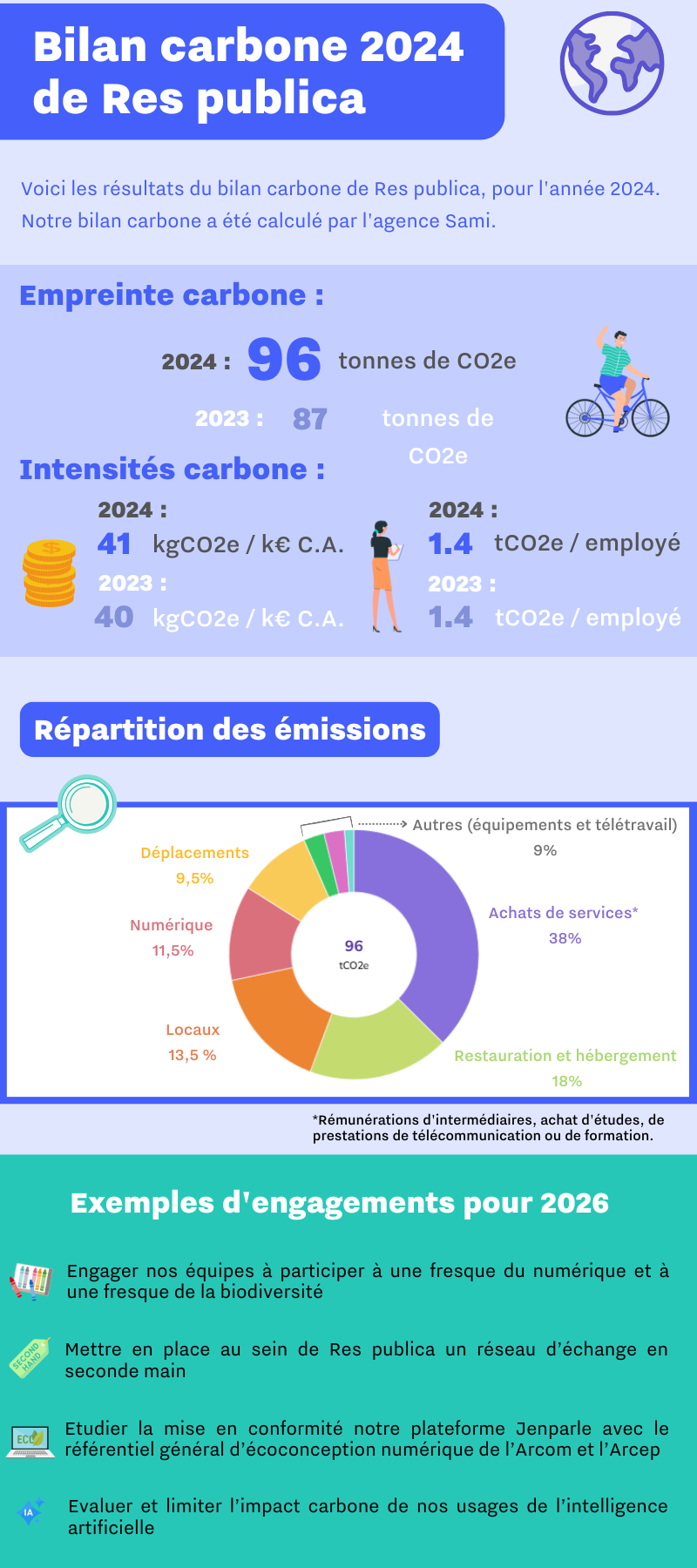
Since 2020, Res publica has been establishing its carbon footprint in order to reduce our carbon footprint in all our activities, in addition to our CSR policy.
What is a carbon footprint?
A carbon footprint assessment is a methodology for quantifying greenhouse gas emissions developed by the French Agency for Ecological Transition (ADEME) in the early 2000s. The calculation takes into account all of an organization's direct and indirect greenhouse gas emissions . Carbon footprint assessments are mandatory every four years for companies with more than 500 employees. To go even further, and following the recommendations of the Citizens' Convention for Climate (which Res publica supported), we have been conducting this assessment annually since 2020, with the help of Sami , a French agency that assists companies in calculating their carbon footprint and developing their low-carbon strategy.
Our carbon footprint assessment is carried out across three "scopes" which designate the different areas of greenhouse gas emissions:
- Scope 1 : direct greenhouse gas emissions, primarily from the combustion of fossil fuels for heating or company vehicles
- Scope 2 : Indirect emissions associated with electricity and heat production
- Scope 3 : all other indirect emissions in the company's value chain (travel, purchases, waste, etc.). It generally encompasses the majority of emissions.

Our carbon footprint assessment is carried out across three "scopes" which designate the different areas of greenhouse gas emissions:
- Scope 1 : direct greenhouse gas emissions, primarily from the combustion of fossil fuels for heating or company vehicles
- Scope 2 : Indirect emissions associated with electricity and heat production
- Scope 3 : all other indirect emissions in the company's value chain (travel, purchases, waste, etc.). It generally encompasses the majority of emissions
Res publica’s 2024 carbon footprint
In 2024, Res publica emitted 96 tonnes of CO2e (CO2 "-e" for "equivalent": this is a unit created by the IPCC, which takes into account all greenhouse gases, the main one being CO2). This 11% increase compared to 2023 can be explained by several reasons:
- Emissions related to catering and accommodation increased by 40% due to a 6% increase in team staff, and the consequent increase in the number of business trips.
- Emissions related to premises increased by 8%, due to higher maintenance costs.
- Digital emissions increased by 45%, due to the rise in cloud and hosting emissions .
- Travel -related emissions have increased by nearly 80% due to several business trips by plane , which were essential for our missions (more than 6 hours by train or boat).
However, despite this increase in our emissions in 2024, the company's economic intensity (the ratio of the company's CO2e emissions to revenue), as well as the employee intensity (the ratio of employee-related emissions to the average workforce over the year) remain unchanged compared to 2023. They are still below the average and median of companies in the same sector, calculated by Sami : 41 kgCO2e/k€ for economic intensity, and 1.4 tonnes per employee for employee intensity.
What do we do next?
Each year, the Res publica teams make strong commitments to limit our emissions as much as possible. The review process allows us to guide the actions we have been implementing for several years and to intensify them whenever possible.
- Recycling and reducing our waste. Containers have been made available to employees to reduce their waste during their lunch break.
- We have reduced the energy consumption of our premises by installing a programmable thermostat and implementing best practices internally. We have also signed a 100% renewable electricity contract with the Enercoop cooperative .
- The use of low-polluting modes of transport for our business trips and home-to-work journeys as much as possible (public transport, train, bicycle, electric car rental).
- Raising awareness among team members about climate issues. Each of us is invited to participate in a Climate Fresk workshop.
- The transfer of funds from our bank accounts to NEF. In doing so, we contribute to the development of this ethical banking cooperative and to the financing of projects with ecological, social, and/or cultural benefits . The investments offered are Finansol- certified , guaranteeing the solidarity and transparency of savings products .
- The use of refurbished computer equipment and household appliances (fridge, coffee maker, etc.)
In 2026, we want to go even further in our commitments:
- Engage our teams to participate in a digital mural and a biodiversity mural
- Establish a second-hand exchange network
- Studying the compliance of our Jenparle platform with the general digital eco-design framework of Arcom and Arcep
- Evaluate and limit the carbon impact of our uses of artificial intelligence
To learn more, visit our public Sami page .

